What Is Normal Water Pressure for a House in Pinewood WA? Is 70 psi Too High?
Most homes should see roughly 40 to 60 psi. A cheap gauge gives you your real number in about five minutes.
Normal water pressure for a house Pinewood WA homeowners should expect is roughly 40 to 60 psi at the hose bib. Is 70 psi too high? It is under the code limit of 80 psi, but it is on the high side for many fixtures.
A cheap gauge tells you your real number in about five minutes. You do not have to guess.
Banging pipes or a leak from high pressure right now? Shut off the main, then call (360) 925-8015. Tell us your address and we give you the arrival window on the phone.
Call (360) 925-8015
The numbers in one place
Here is the range most plumbers work from:
- Under about 40 psi: weak showers, slow fills, trouble when two fixtures run at once.
- About 40 to 60 psi: comfortable for most households. Many plumbers aim for the middle of this range.
- 60 to 80 psi: allowed by code. Fine for many homes, but harder on washers, ice makers, and faucet cartridges over time.
- Over 80 psi: above the plumbing code ceiling. A pressure reducing valve, called a PRV, is the fix.
The 80 psi ceiling comes from the Uniform Plumbing Code, which Washington adopts through WAC 51-56. Comfort is a separate question from code. A house can pass and still wear out parts early.
Test your pressure with a hose bib gauge
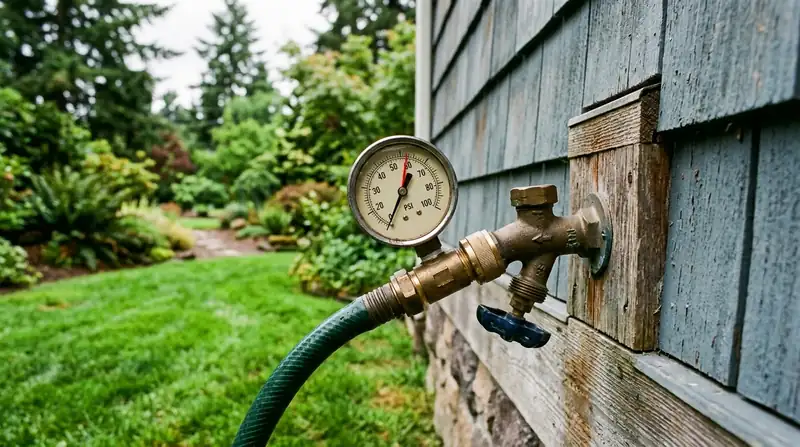
A pressure gauge that threads onto an outdoor hose bib is cheap at any hardware store. Here is the routine:
- Turn off everything that uses water. Dishwasher, washer, ice maker, sprinklers, every tap.
- Thread the gauge onto the hose bib and hand tighten.
- Open the hose bib fully and read the dial.
- Write the number down. Then test again at another time of day.
Why twice? City systems can fluctuate with overall demand, so a reading at 6 a.m. and one at dinnertime can differ. Marysville also warns that pressure can swing during planned maintenance shutdowns and water main flushing, and it says to wait 20 to 30 minutes after crews leave before using taps. See the city's water main flushing page.
Test on a calm day, not right after a flush, so your normal water pressure for a house Pinewood WA baseline is not a bad hour.
Is 70 psi too high for a house?
Not by code, and not an emergency. Seventy is inside the limit.
Still, sustained pressure pushes on every fitting in the house. High pressure can shorten fixture life and, at the extreme, contribute to leaks or burst fittings. If your gauge shows 70 and you are seeing symptoms, a PRV set lower can be worth it.
Symptoms we would look for:
- Banging or hammering when a valve shuts
- A toilet that refills or hisses after it looks done
- Dripping faucets that keep coming back
- Supply hoses or washing machine connections that weep
- A water heater relief valve that drips
None of these proves high pressure. A gauge does. If your reading is 55 and the symptoms continue, the cause is somewhere else and we look there.
When the number is over 80 psi
Code calls for an approved pressure reducing valve where static pressure exceeds 80 psi. It usually sits near where the water line enters the house, and many Pinewood ramblers keep it in a garage wall, crawl space, or utility closet.
Older homes may already have a PRV that has worn out. If your pressure creeps up over the years or jumps at night, a failing PRV is a common suspect. When a PRV is added or replaced, your plumber should also check whether the water heater needs a thermal expansion tank. That is part of the visit, not an upsell.
Some work like this needs a permit. Ask City of Marysville Building Services at 360-363-8000 before anyone opens the line. We give you the answer for your scope before we start. Our water heater permit and seismic strapping page explains how permits work on the heater side.
Low pressure: whose problem is it?
Low pressure has a different checklist.
- Ask a neighbor. If they have it too, call Marysville Public Works at 360-363-8100. After hours, the utility emergency line is 360-363-8350.
- Test the hose bib. A low gauge reading with a good outside supply points to the city side or the main.
- Check whether it is one fixture. A clogged aerator or a partly closed valve is a cheaper fix than a new line.
- Ask when it started. A sudden drop can be a leak, a stuck PRV, or a partly closed main valve.
Still unsure who to call? Start with the gauge. Our low water pressure repair page covers what we look for once the city side is ruled out, and the Marysville water and sewer guide lists who owns what. For everything else, our homepage has the full list.
Questions Pinewood homeowners ask about water pressure
What is the normal psi for residential water pressure?
Most plumbers aim for roughly 40 to 60 psi at the house. The plumbing code ceiling is 80 psi. Below about 40 you may notice weak flow. Test with a hose bib gauge with all fixtures off to see your real number.
Is 70 psi too high for a house?
It is within the 80 psi code limit, so it is not a violation. It can still be hard on fixtures, washer hoses, and valves. If you have banging pipes, weeping supply lines, or running toilets, a PRV set lower is worth discussing.
Can I check my water pressure myself?
Yes. Thread a pressure gauge onto an outdoor hose bib, turn off every fixture, open the bib fully, and read the dial. Repeat at a different time of day, since city pressure can change with demand.
Who do I call when my water pressure is low?
Ask a neighbor first. If theirs is low too, call Marysville Public Works at 360-363-8100, or 360-363-8350 after hours. If only your house is low, call us. We check the PRV, the main valve, and the pipes.
How do I know if my PRV has failed?
Signs include pressure that keeps rising over time, hammering, and fixtures that leak. A gauge reading over 80 psi confirms it. A PRV sits near the water entry, so we test both sides of it to be sure.
Call (360) 925-8015 now. Give us your gauge reading and we tell you on the phone whether it sounds like a PRV, the city, or a fixture.
Call (360) 925-8015