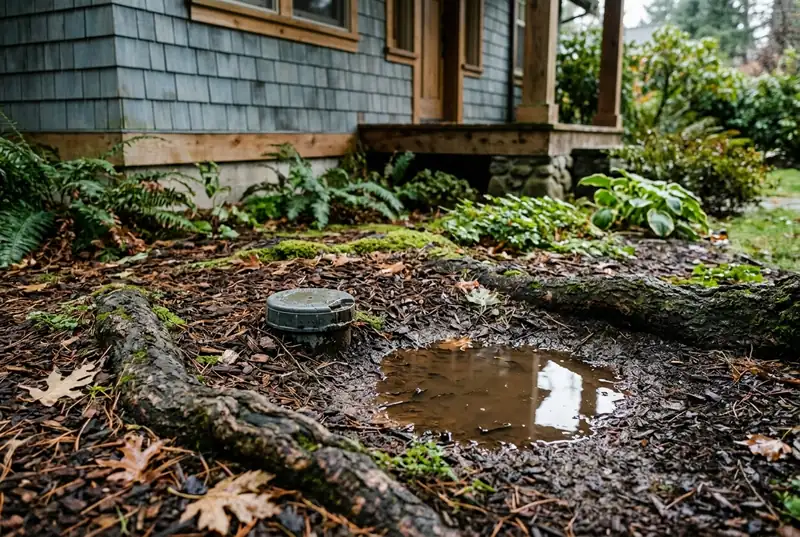
Tree Root Sewer Line Pinewood WA: Signs and Fixes
Roots slip into a joint and keep growing. Learn the early signs, from a slow tub to a gurgle, and what to do next.
Every tree root sewer line Pinewood WA homeowners deal with starts small. A slow tub. A gurgle after the washing machine drains. Then one wet November night, the toilet backs up.
Roots do not crush a pipe from outside. They find a joint, slip in, and keep growing. Here is how to spot them early and what to do next.
Call (360) 925-8015 now if drains are backing up. Tell us your address and we give you the arrival window on the phone.
Call (360) 925-8015
Why pine-lined streets and 1970s side sewers are a bad mix
Roots go where water and nutrients are. A side sewer joint that weeps a little moisture and warmth is an open invitation.
Many homes around Pinewood were built from the 1950s to the 1970s, roughly. Pipe from that era is often clay tile or concrete, laid in short sections with many joints. Every joint is a door.
Newer plastic pipe has tighter joints and holds up better. But age alone proves nothing. Your line could be 50 years old and clean, or 15 years old and half full of hair-thin roots. Only a look inside tells you which.
Six signs the roots are already inside
Watch for these, especially more than one at once:
- Slow drains in several fixtures, not just one sink.
- Gurgling in a toilet or tub when the washer or dishwasher drains.
- A sewer smell near the cleanout, a floor drain, or the yard.
- A wet or unusually green patch on the lawn over the line.
- Repeat clogs every few months after each clearing.
- Water rising in the shower when you flush.
One slow sink is usually a local clog. Several symptoms together point to the main line.
What you can do yourself before you call us
Start with the safe stuff.
- Find your cleanout. It is a capped pipe, often white or black, near the house or the property line. Many older homes have none.
- Go easy on water. Skip the laundry marathon until the line is checked.
- Skip bottled drain cleaner. It does not cut roots, and it sits in the pipe while the line is backed up.
- Call 811 before any digging. It is free, and you must call at least two business days ahead in Washington.
- Confirm who owns what. In most Washington cities the homeowner owns the side sewer from the house to the connection at the main. Marysville Public Works, sewer collection, is at 360-363-8112 to confirm your address.
Digging without locates is how a root problem becomes a gas line problem. Not worth it.
What we do about roots: camera first, cutting second, repair third
We start with a sewer camera inspection. The camera shows the roots, the pipe material, and whether the pipe is cracked or offset. Guessing costs you a torn-up yard.
Then comes the honest part. Cutting or jetting the roots clears the line, but the roots grow back if the joint is still open. On a sound pipe with light roots, periodic clearing can be a fair plan. On a cracked or sagging pipe, clearing is a stopgap.
When the pipe itself is failing, trenchless sewer repair can fix many lines without trenching across the whole yard. Some lines still need a dig. We tell you which one you have, and why, before you decide.
Cost depends on how long the line is and how deep. We give you a conservative range on the call and confirm the real figure once we have seen the pipe.
Questions Pinewood homeowners ask about roots and their side sewer
Is it tree roots or just a regular clog?
One slow drain is usually a local clog. Slow drains in several fixtures, gurgling when the washer drains, repeat backups every few months, or a wet patch on the lawn point to roots in the main line. A camera look confirms it before anyone cuts or digs anything.
How much does it cost to clear tree roots from a sewer line?
Clearing roots from a sewer line usually lands in the low hundreds in our area, and it depends on access and how far down the line the roots sit. A repair is a separate, bigger job. Call us and we give you a range on the phone, then confirm it after we see the pipe.
Will you tell me what the camera shows before I pay for a repair?
Yes. We show you what the camera sees, explain your options in plain words, and give you the price before any cutting, relining, or digging starts. You choose. If clearing the line is enough, we say so, and we do not push a bigger job.
How do I check that a plumber is licensed before letting them scope my sewer?
Look the company up on the Washington L&I contractor lookup, which shows license status, bond, and insurance. Do it before anyone comes in. Our license check guide walks through it. A real contractor is fine with you checking, and it takes about two minutes on your phone. Ask before anyone opens a cleanout or brings equipment inside.
Who owns the side sewer, and who pays to fix roots?
In most Washington cities the homeowner owns the side sewer from the house to the main, so the repair is usually yours. Confirm your address with Marysville Public Works at 360-363-8112. Our side sewer ownership guide explains the usual split, and your policy may cover part.
Do I need a permit to replace or repair a side sewer in Marysville?
Digging up and replacing a side sewer typically needs a permit and an inspection, while clearing roots does not. Ask Marysville Building Services at 360-363-8000 to confirm for your job. Call 811 at least two business days before any digging so buried lines are marked.
Call (360) 925-8015 now. We tell you what we see on camera, in plain words, before you spend on a repair.
Call (360) 925-8015